The MTS Story: London Edition
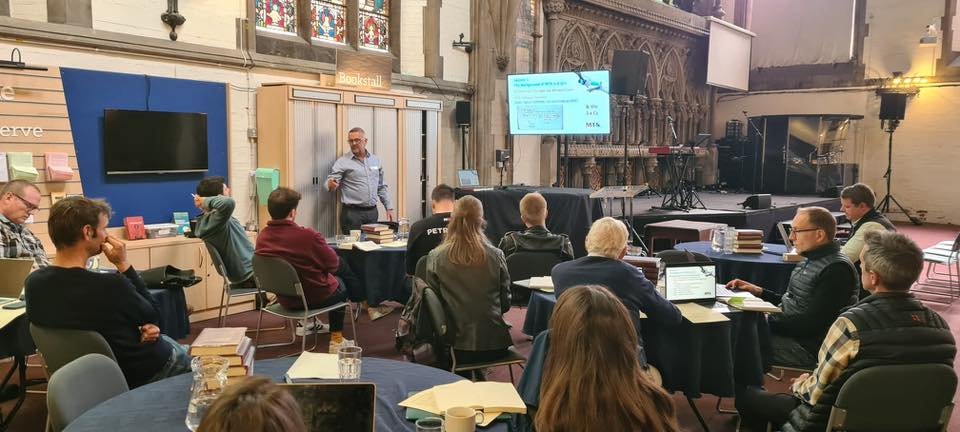
March 2026 | Christ Church Mayfair, London
A year in the making
Twelve months of planning. Two days of conversation. And a room full of people who left with renewed conviction that the billions of lost souls in our world are worth giving everything for.
That’s the story of the MTS London two-day workshop — an event that brought 21 leaders from across four countries together in the heart of London to hear how God has built a movement of healthy gospel ministry trainers in Australia, and to ask what that might mean for the rest of the world.
Ben Pfahlert, National Director of MTS, had been planning the event for a year. “It was a profound event,” he reflected, “the fruit of scores of people praying for months.”
The room
The attendees represented a remarkable cross-section of Christian leadership across the globe. Ranging in age from 30 to 75, they included Vicars and Executive Pastors, International Church Pastors and Church Planters, a representative from a Christian Foundation focused on raising up future leaders, and ministers working in some of the most secular corners of Europe.
Among them: Zeke Nelson, from an Independent Church in Antwerp, Belgium. Matt George, an Australian missionary pastoring an international church in Lisbon, Portugal. Rebekah Leary, based in Budapest. And Richard Perkins, a past MTS apprentice himself, now pastoring King’s Church Guildford in rural England.
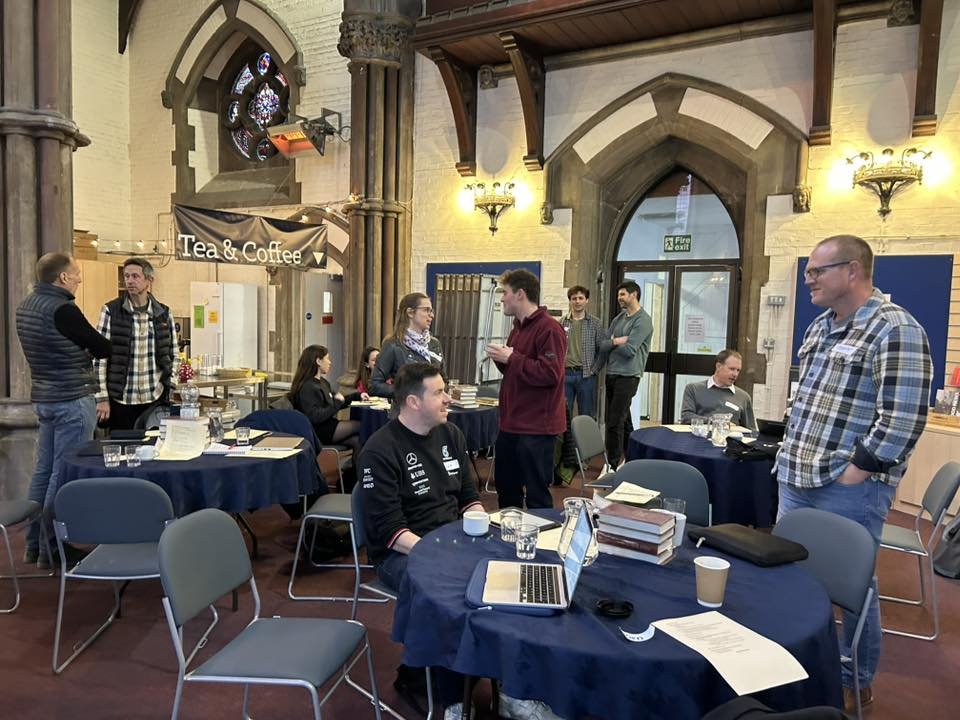
They gathered around tables in groups of four and five. The 71-slide presentation had been sent in advance so attendees could digest the material before arriving. Ben took the slides as read, speaking to key points and opening the floor for round-table discussion.
“The room was relatively reserved for the first hour,” Ben noted. “After that, there was energetic interaction as people thought about the billions of lost souls in our world and how we’ll reach them.”
The story of MTS: From one church to a movement
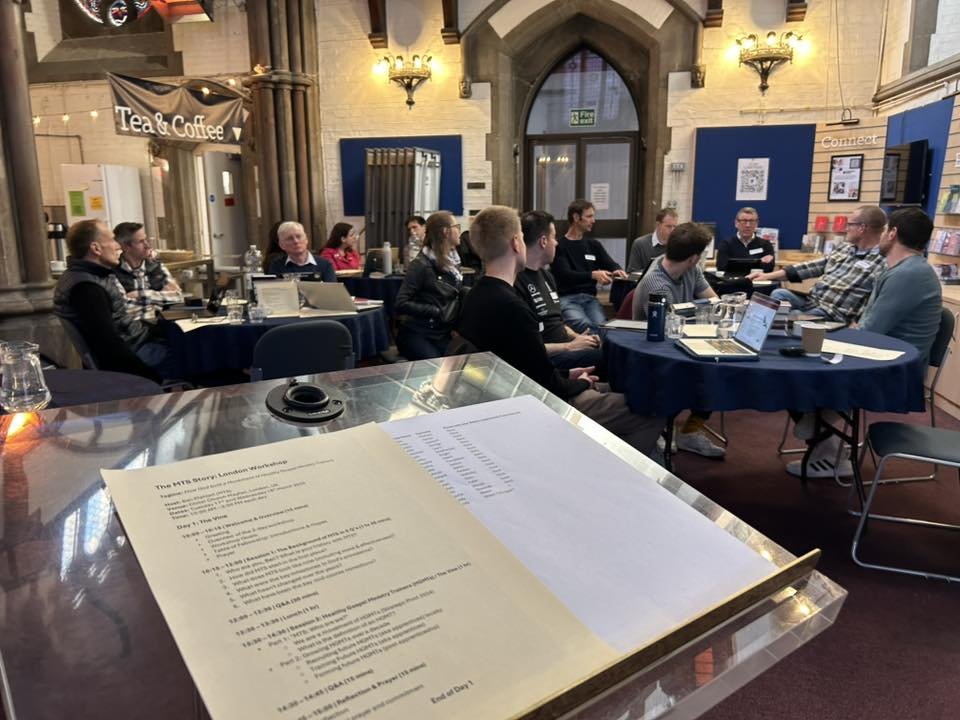
Day One was devoted to “The Vine” — the story of how MTS Australia began, grew, and became a global reference point for gospel ministry training.
Ben walked the room through his own journey: a civil engineering student at RMIT Melbourne who became a Christian in 1989 through a one-to-one conversation with a friend named Rhys Bezzant. He went on to complete an MTS apprenticeship, worked as an engineer while continuing in ministry, studied at Moore Theological College in Sydney, served as an AFES staff worker, and became MTS National Director in 2007 — a role he has held ever since.
The movement itself, he explained, began in 1979 — not with a grand strategy, but almost accidentally. Yet from the beginning, it was built on three convictions: evangelism as the primary motivation; the recognition that recruiting leaders is, as Scripture makes clear, mission critical; and the understanding that “learning by doing” is a key element of ministry formation.
“It started with a recognition that recruiting leaders is biblically mission critical,” Ben explained, drawing on texts from Exodus 18, Matthew 9:38, 2 Timothy 2:2, and Titus 1.
What followed over 46 years is nothing short of remarkable. Today, MTS Australia has trained more than 3,800 apprentices since 1979. More than 1,000 are currently serving in vocational gospel ministry. In recent years, approximately 200 apprentices have been trained annually, supported by around 160 active trainers. Of those who complete an MTS apprenticeship, 56% end up in full-time gospel ministry — a yield rate that speaks for itself.
The movement has also grown internationally. “There are 32 countries with movements of healthy gospel ministry trainers,” Ben told the room. “Some mature, some fledgling.”
What has never changed
Through six key questions about the history and development of MTS, one theme kept resurfacing: the unchanging conviction that the world needs more gospel workers, and that the local church is the place to form them.
Ben quoted two of MTS’ most experienced trainers to capture it:
Tim Thorburn, with 46 years of training behind him: “It’s all about Jesus, evangelism and raising up leaders.”
Rowan Kemp, with 27 years of training: “There are 2.5 billion Christians on planet earth. Therefore, there are billions who don’t know Jesus. Therefore, we need millions of gospel workers.”
The vision of MTS is clear: to win the world for Christ by multiplying gospel workers through ministry apprenticeships. And the purpose of the MTS Head Office is to grow a movement of healthy gospel ministry trainers (HGMTs). The mission: to raise, train and resource those trainers through formation and fellowship.
A movement, Ben reminded attendees, is about “influence and inspiration, not command and control.”
Growing healthy gospel ministry trainers
Day Two turned to “The Trellis” — the structures and support systems that allow the vine to grow.
The session on HGMTs laid out the three “F”s that define what a HGMT looks like in practice: Fellowship (like-minded comrades, gathered in Tables of Fellowship), Formation (nine Trainer Formation Modules of one hour each), and Framework (the trusted administration providing quality pastoral care systems and accountability).
For recruiting future apprentices, Ben walked through “6 Steps to Ministry Apprenticeships.” For training them, resources were given to help get things up and running. And for forming the trainers themselves post-apprenticeship, the nine formation modules cover everything from courageous recruiting and trusted curriculum to Christlike fellowship and healthy training meetings.
The session on building a healthy trellis was equally practical. A movement stalls without strong structures, Ben observed, and a good trellis does for trainers what they cannot do for themselves. It handles conferences, compliance, and resources. It has a clear answer to, “who are you?”. A strategic plan. Good people. And a network of supporters who can give their Prayer LIFE (labour, influence, finances, and expertise).
“There is no ‘success’ without ‘succession,'” Ben reminded the room.
Fruit in the room
By the end of the two days, the evidence of impact was already visible.
Matt George, the Lisbon pastor, asked to have coffee with Ben immediately after the workshop concluded. “Our church is a great place to train apprentices,” he said. “These two days have reignited my zeal to do so. Portugal needs thousands more pastors.”
Zeke Nelson from Belgium found himself, by the end of the two days, with a band of brothers in the UK he hadn’t had before — a Table of Fellowship that could support and encourage his work in Antwerp.
Ben reflected on one of his personal highlights. “There were very experienced people in the room who have lots of runs on the board. If they just reinvigorate the apprentices they themselves have trained in the past, then that would be huge.”
People also identified hurdles — financial support for apprentices was named as a particularly significant one in England — and committed to working together to find solutions.
A pastor writes to his church
Perhaps the most vivid testimony to the workshop’s impact came not from Ben, but from Richard Perkins — a former MTS apprentice at Dundonald Church in London, now pastoring King’s Church Guildford. Richard travelled home from the workshop and, before the week was out, had written his church newsletter entirely about what he’d heard and seen.
Richard didn’t mince words about the need:
“The population of England in the last census: 56,490,048. The average FIEC Church has 70 members… If we’re going to provide an average FIEC church for everyone in England, then we’re going to need to raise up 564,900 pastors. That’s the training task ahead of us.”
And he was equally direct about what MTS showed him:
“MTS is a gamechanger. It’s the Ministry Training Strategy. It’s Australian. And it works.”
Richard reflected on the pipeline problem facing the English church: without intentional, local church-based training, there simply won’t be enough gospel workers. But he was also clear about where that training happens best.
“I would argue there is nowhere better to learn than at a church like ours. Our small, imperfect, normal local church… A [ministry apprentice] can lead a Ministry Team, prep a kids’ slot, run an event, read one to one with a non-Christian, do some walk up evangelism on campus, prepare Life Group Prep Notes, launch a new ministry, lead the Prayer Meeting and preach a series.”
For Richard, the workshop wasn’t abstract theory. It connected directly to his own story: a pastor who suggested he do a few more years of ministry before theological college, and whose tap on the shoulder changed the direction of his life. “Without realising it, doing a ministry apprenticeship is how I got into gospel ministry,” he wrote.
The global body at work
The workshop was generously hosted across two days by Christ Church Mayfair, with key friendships and partnerships woven throughout — including the teams at Co-Mission, Proclamation Trust, and The London Project.
Ben stepped back at the end to reflect on something bigger than the event itself.
“Pondering afresh just how amazing our situation in Australia is, God really has done a miracle through the MTS movement in the last 46 years,” he said. And then, looking around the room at leaders from Belgium, Portugal, Hungary, England, and beyond: “The global body of Christ is the best.”
His prayer as the workshop closed: “May God the Father bring glory to Jesus through the growth of existing and new movements of healthy gospel ministry trainers globally.”
It is a prayer that, in that London room in March 2026, began to feel a little closer to being answered, “Yes!”
Related Stories
Seeds in unlikely soil: How MTS is taking root in Slovenia
Read More 
Raising faithful gospel workers: An update from MAT Zimbabwe, February 2026
Read More 
Pressing on together: An update from MAT Zimbabwe
Read More 
Ministry Apprentice Training in Zimbabwe: Training apprentices to pass the gospel on
Read More